- UpperWraps the foot and holds the fit.
- FoamCompresses under load. Stores and returns some energy.
- Curved plateResists bending and changes how the system is loaded.
- Rocker + outsoleShape guides the roll. Rubber meets the road.
Different jobs. Shared load.Soft foam, a stiff curved element and a shaped sole change how a shoe responds.
Conceptual anatomy. Layer placement and geometry vary between shoes.
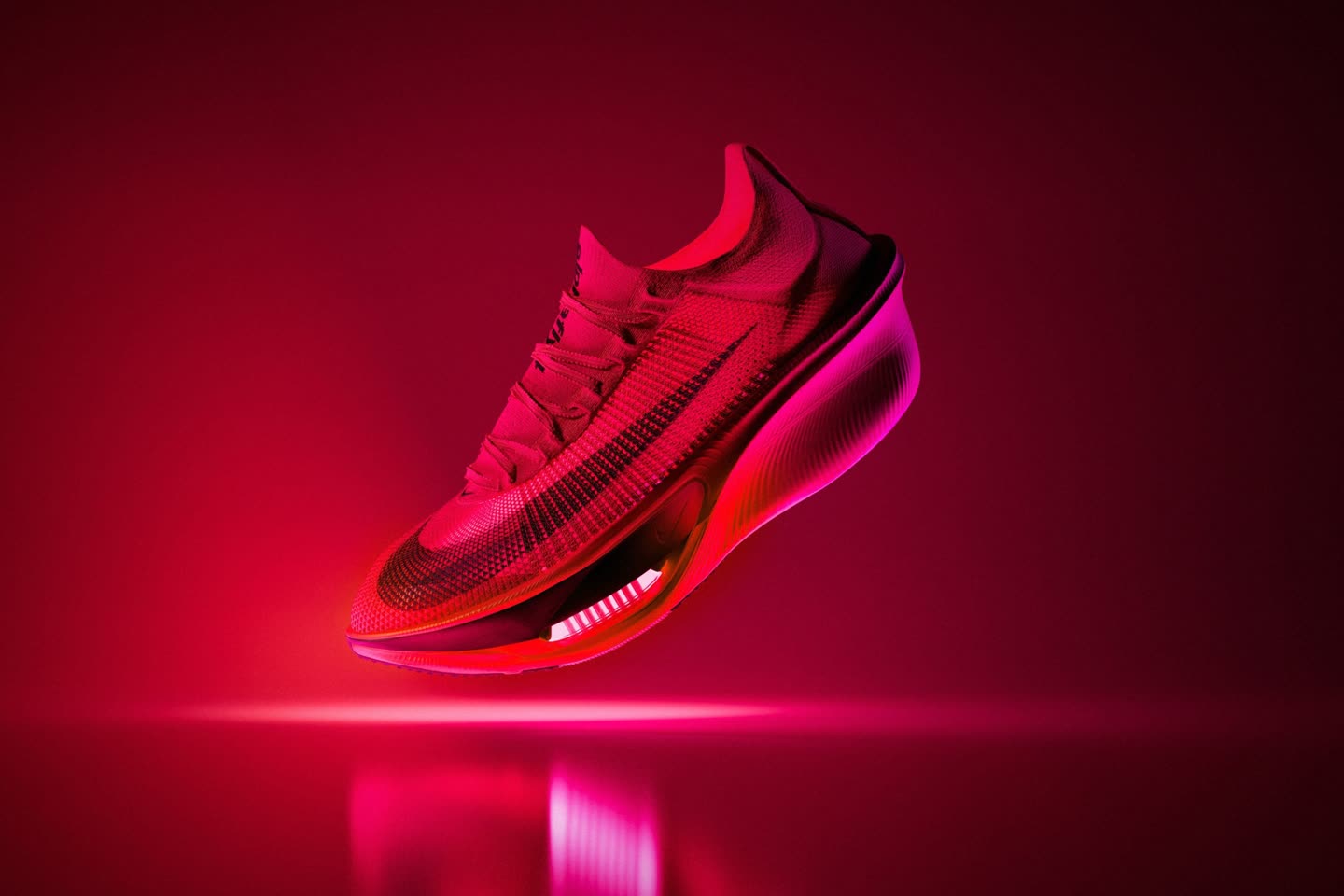
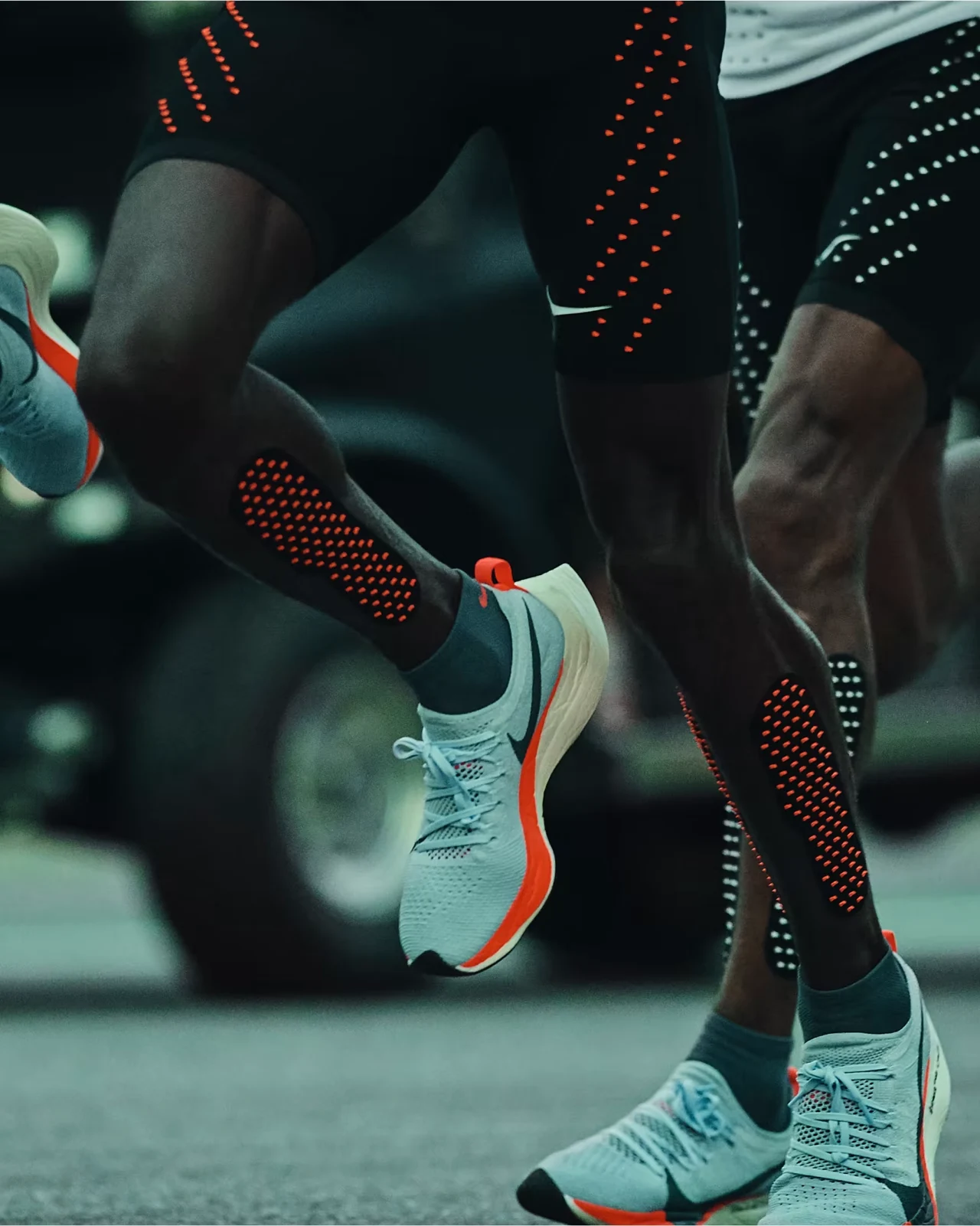
Nike Alphafly 4 · Photography: Nike ↗
Scroll to look inside
Engineered
to Run.
A super shoe is a material, a structure and a shape.
- UpperWraps the foot and holds the fit.
- FoamCompresses under load, storing and returning some energy.
- Carbon plateResists bending and changes how the shoe is loaded.
- Rocker + outsoleShape guides the roll; the outsole meets the road.
Photograph: Nike Alphafly 4. Model: generic anatomy, not this product or a product specification.
Showing the illustrated diagram. You can still explore every stage.
Four parts.
One moving system.
Foam deforms. A curved plate directs load. The upper holds the foot. The outsole meets the road.
Plays once when you reach it.
Inspect at your own pace
A stride before.
From a legend in sandals
to an imagined future.
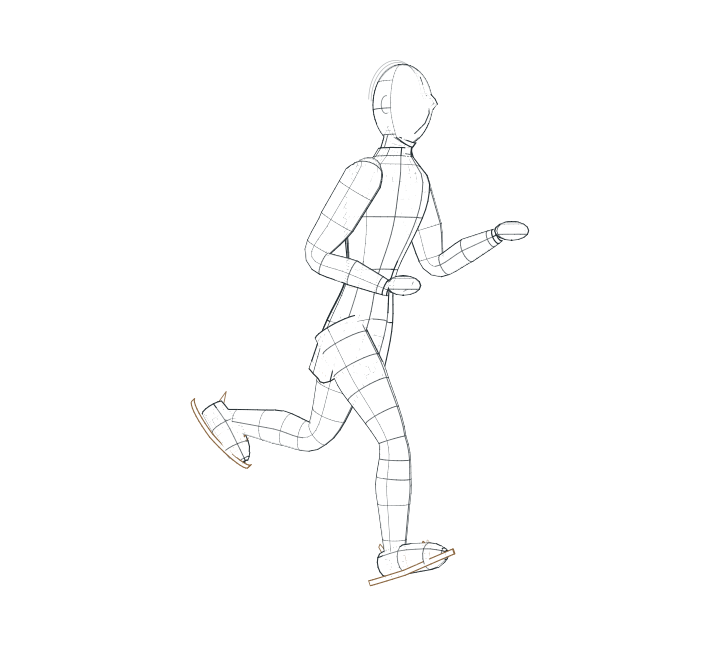
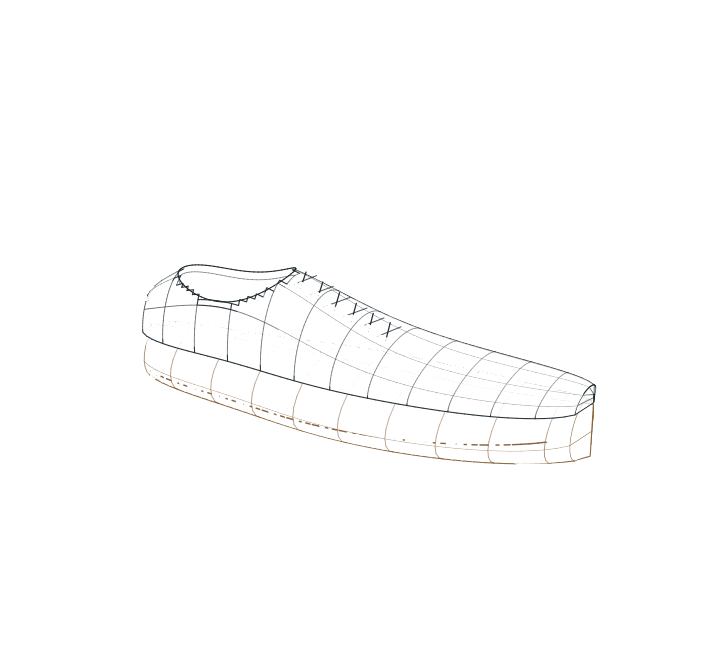
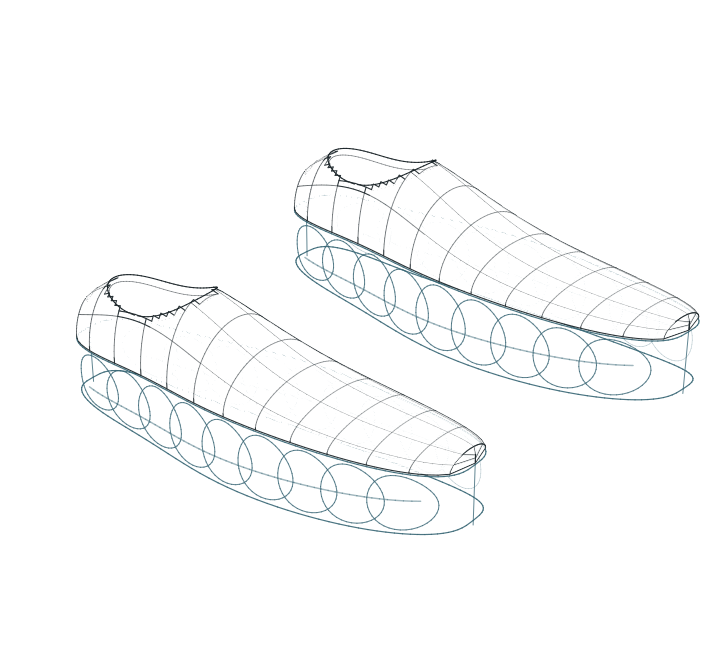
The opening moves from an imagined ancient Greek runner in sandals, through a modern super shoe, to a speculative pair from the 22nd century.
A stride before the science.
An ancient messenger, imagined in flat sandals.
An artistic journey, from the marathon legend to a speculative future. The ancient runner’s footwear is an interpretation; the final pair is not a product or a performance prediction.
A little more spring.
A lot of engineering.
A super shoe is more than a slab of foam and a carbon plate. It’s a system that bends, compresses and returns energy—with a runner at the centre.
See how it is madeThe race changed.
So did the shoe.
More room to compress. Less material to carry. The design challenge became fitting useful spring under a runner while controlling mass and stability.
Kipchoge’s 2:00:25 at Breaking2 in 2017. Then 1:59:40.2 in Vienna in 2019. Both were exhibitions. The shoe was one part of the system.
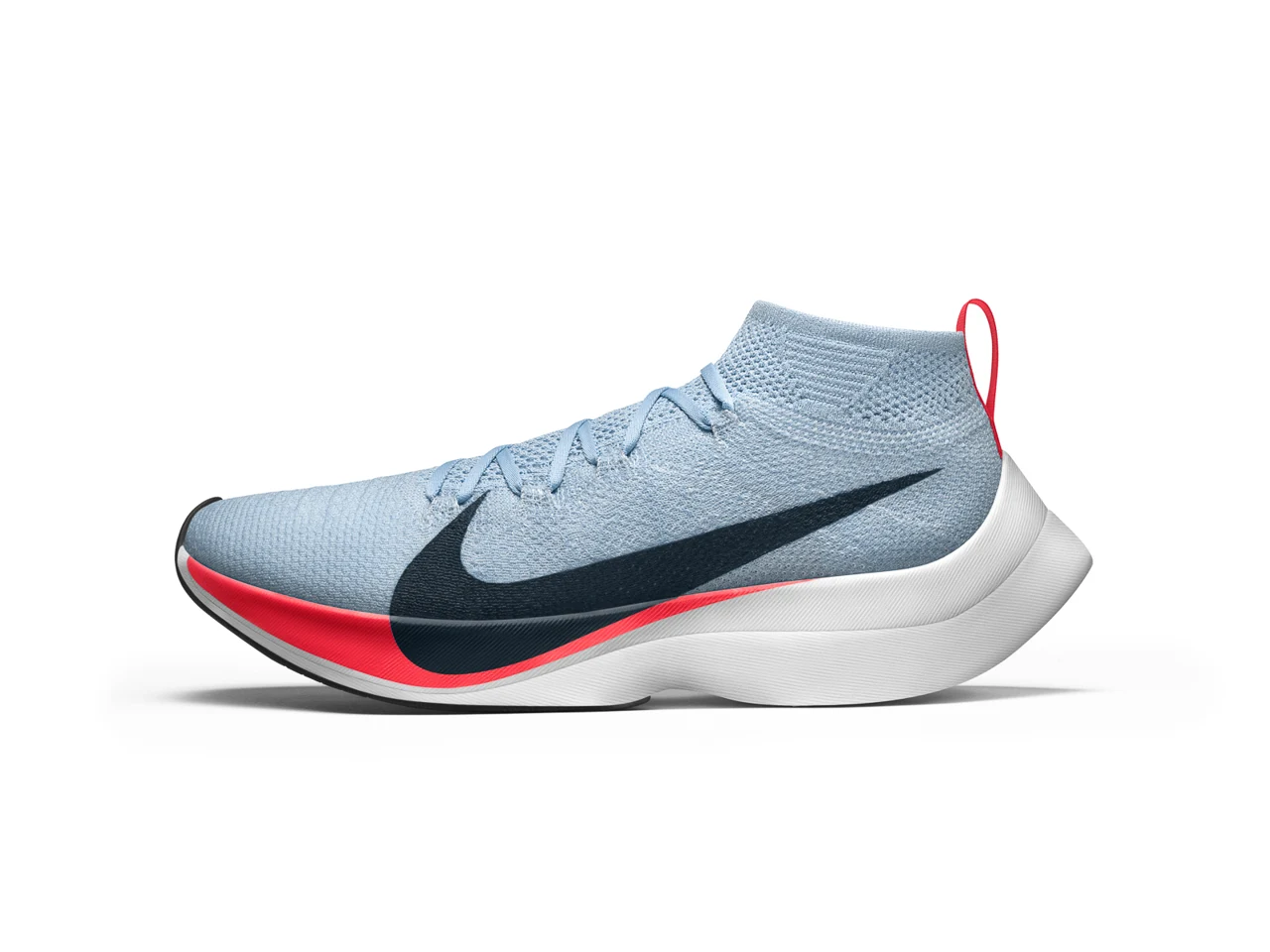

Enlarged cellular schematic
Geometry and timing are illustrative.
How does a polymer
become a spring?
The material is only the beginning. The process gives it structure.
- Dissolve
- Nucleate
- Grow
- Set
Gas dissolves in the polymer under pressure.
- Gas dissolvesPressure helps gas dissolve into the polymer.
- Cells form and growAs pressure falls, cells form and expand.
- SetCooling stabilizes the cellular structure.
One physical-foaming route. Glass-to-matte shading marks cooling. Zhang et al., 2025 ↗
Showing the illustrated diagram. You can still explore every stage.
The process
makes the foam.
Gas forms cells inside a polymer. Their structure helps shape how the foam behaves.
Plays once when you reach it.
Inspect the process & compare routes
Gas dissolves in the polymer under pressure.
One general physical foaming route. Commercial formulations and production methods vary.
Process source ↗- Load comes inThe upper surface presses down on the cellular structure.
- Walls deformThe polymer network bends as the foam compresses.
- The structure recoversRemoving the load lets the cells recover. Some energy is lost.
Release.The structure recovers and returns some of the stored energy.
Illustrative cell structure and deformation. Not a calibrated material test.
What does the
empty space do?
Cell walls deform under load, then recover. Compression and energy return describe different things.
- LoadA downward load compresses the foam.
- CompressionHow far it deforms under a given load.
- ReturnSome stored energy returns on release; some is dissipated as heat.
Glass forms mark cell spaces; real foam deforms through its cell walls. Shape recovery is not energy return. Hoogkamer et al., 2018 ↗
Showing the illustrated diagram. You can still explore every stage.
Small cells.
Useful spring.
The cell walls deform under load. How far they compress and how much energy they return both matter.
Plays once when you reach it.
Inspect at your own pace
Why does strength
have a direction?
This schematic stacks four plies. Fibre direction changes how a laminate bends.
- One plyFibres resist stretching most strongly along their length.
- Four angles, one sheetThis example combines 0°, +45°, −45° and 90° plies.
- Shaped and curedThe illustrated layup is shaped and cured; commercial methods vary.
Illustrative thermoset layup. Four angles are one example; commercial processes vary. Hexcel prepreg technology ↗
Showing the illustrated diagram. You can still explore every stage.
Why does strength
have a direction?
Fiber angles change how a laminate carries load. Multiple plies become one curved plate.
Plays once when you reach it.
Inspect the layers
Fiber angles shape the load path.
Fiber direction changes how a laminate carries load. Illustrative thermoset layup; commercial processes vary.
Composite process ↗Weight is one question.
Shape is another.
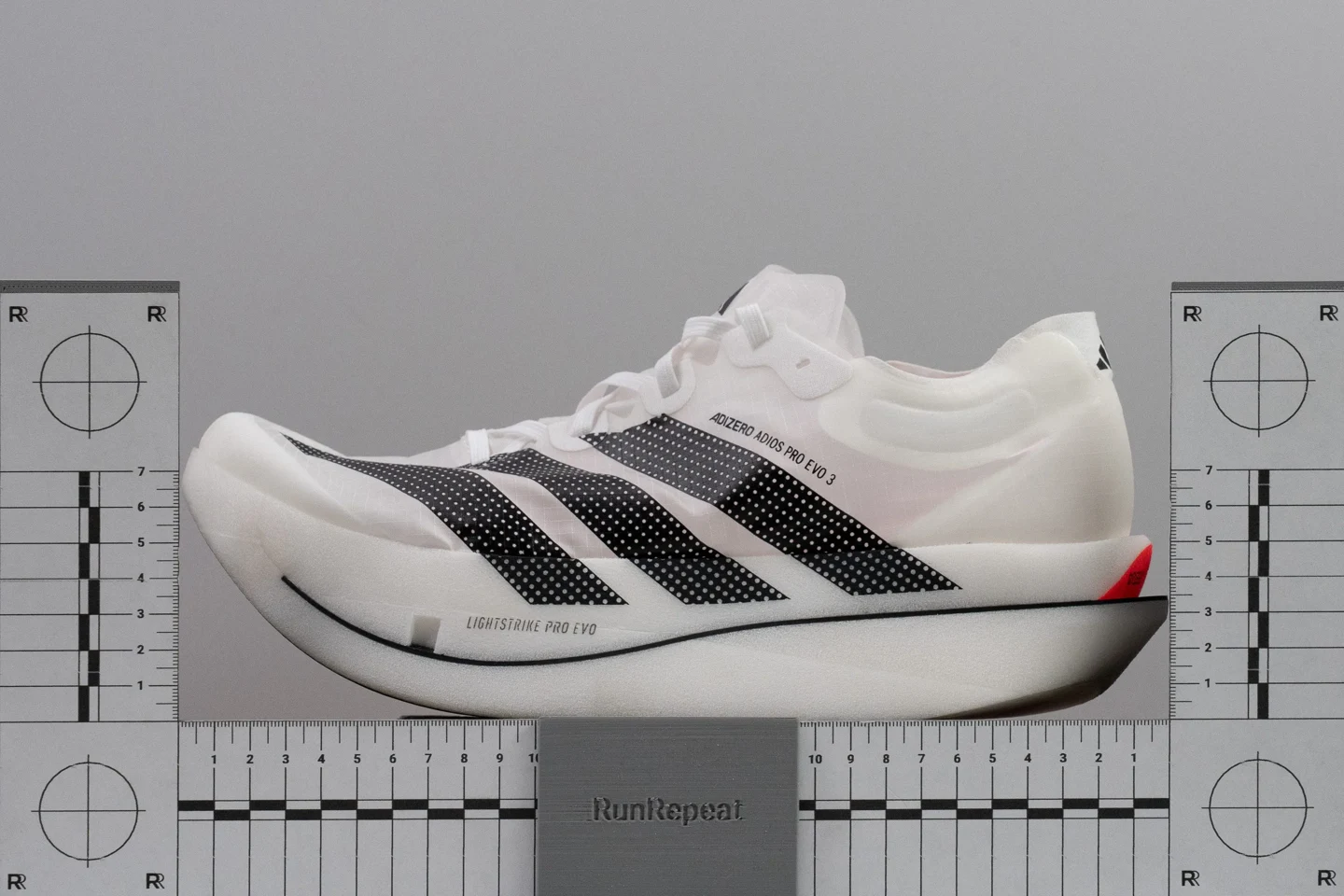
Look at the same shoe model in two ways. A scale shows mass. A side profile reveals curvature.


- A changing contactThe contact region shifts forward through the step.
- A loaded midsoleFoam, plate and foot share the load.
- A curved transitionRocker geometry helps govern the roll toward toe-off.
Roll toward toe-off.The heel rises and contact moves toward the forefoot.
One simplified rearfoot-contact sequence. Runners land differently; this is not a pressure map.
What happens
in one step?
A simplified rearfoot-contact step shows how the shoe meets the ground. Runners land differently.
- Contact movesIn this example, contact begins at the heel and moves forward.
- MidstanceThe foot and shoe share load through ground contact.
- Toward toe-offThe heel lifts as contact moves toward the forefoot.
Schematic rearfoot-contact sequence, not a measured pressure trace or gait model. Hoogkamer et al., 2019 ↗
Showing the illustrated diagram. You can still explore every stage.
A curve changes
the transition.
As loading moves forward, plate, foam and rocker work together. No component tells the whole story.
Plays once when you reach it.
Inspect at your own pace
A shoe upper.
Spun into place.
A robot lays a continuous filament around a last. The textile takes shape in three dimensions.
Generic last and path illustration
Plays once when you reach it.
Inspect the forming upper
1.5 km
of filament per upper, reported by On
3 min
for upper formation, reported by On
Manufacturer figures: On LightSpray, July 2025
On reports a 1.5-kilometre filament and a three-minute process for its one-piece LightSpray upper. These figures describe the upper, not a finished shoe. The animation is a generic illustration of depositing filament on a last; it does not reproduce On’s equipment, tool path or production speed. Read On’s factory announcement.
How much
comes back?
In this historical whole-shoe test, the prototype returned more joules. The percentage alone doesn’t tell the whole story.
Compression
Downward displacement · mm
Nike prototype
Returned energy
Mechanical energy · J
Nike prototype
Resilience
Share of stored energy returned · %
Nike prototype
Whole-shoe laboratory test, about 2,000 N peak force over 185 ms. These measured endpoints compare one historical prototype with two racing shoes, not isolated foams. Hoogkamer et al., Figure 3 ↗
The share returned matters. So does how much energy was stored. Greater compression was a major contributor to the prototype’s greater energy return.
Less energy at the same speed.
Eighteen male runners. Mass-matched shoes. Three running speeds. The result does not mean every runner finishes every race four percent faster.
Hoogkamer et al., 2018 ↗The average doesn’t
choose your shoe.
Three super shoes. Twenty-two trained runners. Similar group results—and a different story within each runner.
Across the group.
Mean energetic cost of transport (J/kg/m)
Mean ± standard deviation. No significant difference (p = 0.246). This does not establish equivalence.
Within each runner.
Observed best-to-worst shoe difference
2.71%average difference
Reported range, not a prediction or confidence interval. One trial per shoe; measurement variability can affect individual differences.
What works
for your stride?
Look past the ingredient list. Ask what deforms, what directs the load, and what was actually measured.
Go deeper into the researchRead the full article
The story behind the system
Engineered to Run
Adapted from Engineered to Run. For Stanford d.school students who run. Research cutoff: .
01The design problem
How much useful spring fits under a runner?
Old racing flats asked how little shoe a fast runner could tolerate. Super shoes ask how much useful spring can fit underfoot before mass and instability erase the gain.
Breaking2 made the new system visible: tall, low-density foam, a curved stiff element, rocker geometry and a controlled race environment. The shoe was one part of the sub-two-hour story.
In the original Vaporfly study, the prototype returned more mechanical energy mainly because it compressed much more, alongside its greater resilience. The total energy returned matters as well as the percentage returned. [1]
How the question changed
- 2013
- Expanded TPU bead foam, seen in Boost, showed that midsoles could be resilient and temperature-stable without being conventional EVA. [8]
- 2017
- Kipchoge runs 2:00:25 at Breaking2 in Monza. An exhibition, not a ratified record.
- 2018
- Hoogkamer and colleagues publish a controlled study showing about 4% average energetic-cost reduction. [1]
- 2019
- INEOS 1:59:40.2 passes the two-hour barrier in another exhibition. Biomechanics papers complicate the carbon-spring explanation. [2]
02Foam
Foam is architecture.
A foam has chemistry, a brand, a manufacturing process, a cell structure and a final behavior inside the shoe. PEBA, TPU, aliphatic TPU, TPEE and EVA are material families. Their names alone do not specify a finished midsole’s performance. [7] [8]
The runner feels density, compression, rebound, shear stability, fatigue and temperature behavior. Processing and cellular structure help shape those properties.
Supercritical processing involves controlled gas dissolution, nucleation and cell growth. It does not simply mean larger air pockets. [9]
Percent resilience describes the share of energy returned. How much energy a shoe stores and returns also depends on how it deforms under load. In the early prototype study, greater compression was a major contributor to its greater mechanical energy return. [1]
The interactive foam is a schematic. Cell shapes and deformation are illustrative, with no calibrated material properties.
03Plate and geometry
The plate manages motion.
Carbon composites carry loads directionally: fiber orientation and laminate layup influence their stiffness. Inside a shoe, the plate can reduce toe bending, spread load through the foam, stabilize the stack and work with the rocker geometry. [2]
The plate is not a standalone trampoline. In one Vaporfly study, cutting the plate reduced bending stiffness without substantially changing running economy. The finding points back to the interaction between components; it does not establish that all plates are ineffective. [3]
“The plate amplifies the foam” is a tempting shortcut. The more careful description is that the plate shapes how the runner loads the foam and joints. A separate amplification mechanism is not directly demonstrated by that statement.
The rocker contributes through shape. Its curve helps govern the transition through contact as loading moves forward. The useful question concerns foam, structure, geometry and the runner together.
04Evidence
Economy is not speed.
- Mechanical energy return
- A shoe or material test measures how much mechanical energy comes back.
- Running economy
- Metabolic cost is measured while a runner maintains a fixed speed.
- Race performance
- Time over distance also involves fatigue, weather, pacing and tactics.
The early “4%” was an average reduction in energetic cost in a controlled laboratory comparison. It was not a universal race-time discount. [1]
Kipp, Kram and Hoogkamer modeled why an economy gain can translate into a smaller speed gain at elite marathon pace. A rough translation may be closer to two-thirds of the economy improvement, depending on speed and assumptions. This is a modeled relationship, not a personal prediction. [4]
Later studies show that both the shoe model and the runner’s response matter. Materials and geometry change what a shoe can offer; individual response helps determine what happens in use. [5] [6]
Look past the ingredient list. Ask what deforms, what directs the load and what was actually measured. A review can describe feel, fit and use. It cannot establish a metabolic benefit.
The supplied article’s optional slider model used invented coefficients to illustrate tradeoffs. Neither that model nor the schematic 3D interactions predict physiology or marathon performance.
05Sources
The research and material references carried with the supplied article, with its September 14, 2026 cutoff.
- Hoogkamer et al. · 2018
Controlled energetic-cost study, including the original Vaporfly result and the deformation/energy-return distinction.
- Hoogkamer et al. · 2019
Biomechanics of the running-shoe system.
- Healey & Hoogkamer · 2022
The plate-cutting experiment. Publisher link substituted for an unrelated DOI in the supplied article; full text not rechecked.
- Kipp, Kram & Hoogkamer · 2019
Modeled relationship between metabolic savings and speed.
- Joubert & Jones · 2022
Comparison across running-shoe models.
- Fohrmann et al. · 2026
Individual response to advanced footwear.
- Arkema · Pebax elastomer family
Manufacturer reference for material-family background.
- BASF · Infinergy
Manufacturer reference for expanded TPU bead foam.
- Supercritical TPU review
Processing and cellular structure.
- World Athletics · Shoe regulations
The regulations referenced by the supplied article.
+Supporting field notes
What that feels like on a run.
Three source excerpts about the Adidas Adizero EVO SL, a daily trainer. These are observations about ride, fit and preference, separate from measured biomechanics and running economy.
I think it's a really strong daily trainer and I'm really looking forward to go out and running in it again
Adidas Adizero Evo SL First Run Review: An exciting new daily trainer · 5:24
So, that's my take on that industry disruptor, the Adidas Adizero Evo SL. I mean, I've got three pairs. I wear two of them. The ATR model isn't my cup of tea at all. So, wearing a bin bag on your foot. It's all about the woven version for me. That is pure heaven.
the newer production model, which is going to run a little bit smaller, a little bit tighter, and you may want to size up half a size to get the fit you want
YEAH review verdict
Adidas Adizero EVO SL · D · 73/100 · Consider
CONSIDER at MED confidence — 68 reviews across 11 creators
Stored review consensus from the supplied fixture. This is separate from the article’s laboratory evidence and does not measure running economy. The fixture’s grade ladder places scores below 76 in D.
Manufacturing sources & methods
The original article’s research cutoff remains 14 September 2026. Manufacturing sources and the plotted studies were checked on 20 September 2026. All process scenes are authored schematics.
Photography update, 20 September 2026: Nike Alphafly 4 official photography and film, published 17 September. Product media illustrates surface detail; the anatomy scenes are generic, and the historical study graphics identify the shoes actually tested. Light reveals are editorial presentation effects. Media credit: Nike.
- Zhang et al., 2025: physical foaming review
Gas dissolution, nucleation, cell growth and stabilization. Full text checked. This review describes mechanisms, not a proprietary commercial foam recipe. - BASF: expanded TPU and steam fusion
Manufacturer account of the Infinergy / Energy Boost bead route. Internal cells and the larger bead structure are separate scales. - Zhang et al., 2021: TPU bead and sheet experiments
Abstract and captions checked. Distinguishes making expanded beads from molding them together; not a universal recipe. - Hexcel: Prepreg Technology manual
General composite layup, consolidation and cure. The illustrative thermoset route does not establish any shoe maker’s layup or processing cycle. - On: LightSpray factory, July 2025
Manufacturer-reported filament length and time for upper formation only. Robot path and last are generic illustrations.
The mechanical infographic uses published whole-shoe endpoints. It does not reconstruct a measured force curve. The 2026 range uses the reported minimum, maximum and mean; no individual participant observations have been fabricated.
Photography & illustration credits
Opening: original procedural 3D line artwork created for YEAH. The ancient runner interprets the marathon legend; the sandals are an artistic choice. Modern footwear is generic. The final pair imagines the 22nd century, without performance claims. This is an editorial sequence, not a historical reconstruction or measured simulation.
Vienna 2019: Triathlet 79, via Wikimedia Commons, CC BY-SA 4.0. The final 200 metres of the INEOS 1:59 Challenge, 12 October 2019. Resized and converted to WebP; published image variants retain CC BY-SA 4.0. Documentary use does not imply athlete endorsement.
Breaking2 stride photograph and 2017 Zoom Vaporfly Elite product photograph: Nike, from the supplied files; resized and converted to WebP. Breaking2 context · 2017 product release.
Adizero Adios Pro Evo 3 on a scale: adidas product media, supplied in the handover. Rocker photograph: RunRepeat, supplied separately; resized. These images are credited to their sources and do not establish a performance result or imply endorsement.
Nike Alphafly 4 film and product photographs: Nike, from the supplied feature. Authored technical graphics are generic explanatory schematics. The original article and research references are preserved above.